BOPP/BOPLA/BOPET Film production line
Date:2023-03-23 11:08:04
Biaxially Oriented Film Production Lines | BOPP, BOPE, BOPLA, BOPET, BOPI, BOPA, BOPS
Product Line Overview
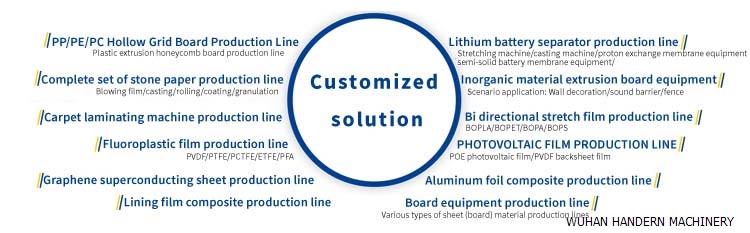
We supply complete production lines for seven major and specialty biaxially oriented films: BOPP, BOPE, BOPLA, BOPET, BOPI, BOPA and BOPS. Lines are available for both sequential biaxial stretching and simultaneous biaxial stretching processes, and are customized according to target film type, capacity planning and plant conditions. Each line covers raw material feeding and pretreatment, extrusion and casting, machine direction orientation (MDO), transverse direction orientation (TDO), pulling and winding, slitting, and process automation control, delivering high-consistency biaxially oriented films for packaging, electronics, new energy, medical and industrial applications.
1. BOPP Production Line (Biaxially Oriented Polypropylene Film)
Film Characteristics and Positioning
BOPP is the highest-volume and most mature biaxially oriented film type, offering excellent mechanical strength, electrical insulation, cold resistance and dimensional stability. It is a base material for flexible food packaging, adhesive tapes, capacitor films and laminated packaging.
Target Applications
Food packaging, candy/snack packaging, adhesive tape base film, capacitor dielectric film, printing and lamination substrates, pearlized/white film and other specialty packaging.
Process Route
Sequential biaxial stretching is the mainstream route, with 3-layer, 5-layer and 7-layer co-extrusion configurations. Multilayer co-extrusion significantly improves barrier and freshness-preservation performance and supports functional structures such as pearlized masterbatch layers and heat-seal layers. Simultaneous stretching routes can also be configured according to product requirements.
Typical Technical Specifications
-
Finished web width: 6.6 m — 10.4 m; next-generation 12 m-class lines available on request
-
Mechanical speed: 450 — 700 m/min (advanced models up to 700 m/min)
-
Film thickness: 12 — 60 μm
-
Annual capacity: 25,000 — 67,000 t/a (depending on width and speed configuration)
-
Thickness control accuracy: within ±1 μm under high-speed operation
Reference data: typical commercial line configurations and publicly available equipment specifications; final guaranteed values are subject to the agreed process guarantee.
2. BOPE Production Line (Biaxially Oriented Polyethylene Film)
Film Characteristics and Positioning
BOPE is a core film type for mono-material recyclable packaging. It combines high stiffness, excellent heat-seal strength, outstanding transparency and barrier performance, and linear tear opening. It offers strong puncture resistance and optical properties and can be combined with PE blown film or BOPE-LLD to achieve 100% PE mono-material packaging.
Target Applications
Food packaging, pharmaceutical and medical packaging, pet food packaging, industrial and agricultural packaging, consumer goods packaging, and sustainable/recyclable packaging solutions.
Process Route
Sequential biaxial stretching with MDO and TDO, suitable for high-density, low-melt-index PE grades. MDO stretch ratio is typically 5:1 — 9:1, and TDO stretch ratio 7:1 — 12:1. A BOPP/BOPE hybrid production line can also be configured for flexible switching between PP and PE on the same line.
Typical Technical Specifications
-
Finished web width: 6.6 m / 8.7 m / 10.4 m
-
PE production speed: 450 — 525 m/min
-
Film thickness: 12 — 60 μm
-
PE annual capacity: 25,200 — 50,000 t/a (based on 8,000 hours)
Reference data: typical commercial line configurations and publicly available equipment specifications; final guaranteed values are subject to the agreed process guarantee.
3. BOPLA Production Line (Biaxially Oriented Polylactic Acid Film)
Film Characteristics and Positioning
BOPLA is a bio-based biodegradable biaxially oriented film. While maintaining good mechanical and electrical properties, it offers excellent cold resistance, gas tightness and dimensional stability, making it an environmentally friendly alternative to conventional packaging films.
Target Applications
Food packaging, cigarette packaging, flower packaging, adhesive tapes, agricultural films and biodegradable packaging applications.
Process Route
Sequential biaxial stretching configuration, with dedicated design of extrusion, casting and stretching temperature windows to match the crystallization and heat-sensitive characteristics of PLA. Machine direction stretch ratio: 1:1 — 1:5; transverse direction stretch ratio: 1:1 — 1:4. Stretching temperature and heat-setting conditions are adjustable according to formulation and film application.
Typical Technical Specifications
-
Finished web width: 5,200 mm
-
Mechanical speed: 200 m/min
-
Film thickness: 12 — 75 μm
-
Annual capacity: 8,000 t/a
Reference data: typical commercial line configurations and publicly available equipment specifications; final guaranteed values are subject to the agreed process guarantee.
4. BOPET Production Line (Biaxially Oriented Polyethylene Terephthalate Film)
Film Characteristics and Positioning
BOPET is known for its excellent mechanical strength, heat resistance, electrical insulation and dimensional stability. It is one of the most widely used high-performance biaxially oriented films in packaging, electronics, display and industrial fields. By application, it can be divided into packaging-grade BOPET and industrial-grade BOPET (photovoltaic, electronic, insulation, release film, etc.).
Target Applications
Flexible and laminated packaging, electrical insulation, flexible circuits and display substrates, solar backsheets, release/protective films, hot stamping foils, cable wrapping, and 5G and microelectronics materials.
Process Route
Sequential biaxial stretching is the main route. An inline coating unit can be integrated to apply and cure water-based coatings between MDO and TDO, eliminating offline coating processes and imparting printability, antistatic, release or adhesion-promoting functions. MDO stretch ratio: 1:1 — 1:5; TDO stretch ratio: 1:2.5 — 1:4.
Typical Technical Specifications
-
Finished web width: 3,500 — 8,700 mm (industrial-grade lines can cover wider ranges)
-
Mechanical speed: 200 — 500 m/min (packaging-grade high-speed lines up to 650 — 700 m/min)
-
Film thickness: 3 — 350 μm (by application segment)
-
Annual capacity: 8,000 — 35,000 t/a
Reference data: typical commercial line configurations and publicly available equipment specifications; final guaranteed values are subject to the agreed process guarantee.
5. BOPI Production Line (Biaxially Oriented Polyimide Film)
Film Characteristics and Positioning
BOPI is one of the highest heat-resistant specialty engineering films, with a long-term service temperature range of —269°C to +260°C and short-term operation at +400°C. It also offers resistance to atomic radiation and is an irreplaceable material for flexible circuit boards, high-end insulation and aerospace applications.
Target Applications
Flexible printed circuit board (FPCB) substrates, high-temperature insulation, aerospace and defense, and radiation-resistant applications in the nuclear industry.
Process Route
Based on the two-step process of casting polyamic acid solution into film followed by imidization and biaxial stretching. The TDO must operate stably in the high-temperature range of 200 — 400°C, placing extremely high demands on the thermal stability and temperature uniformity of the transverse stretching machine. Stretch ratios are relatively moderate (machine direction 1:1 — 1:1.5, transverse direction in the same range). The core process lies in orientation control and heat treatment at high temperature.
Typical Technical Specifications
-
Finished web width: 1,200 — 2,200 mm
-
Mechanical speed: 7.5 — 10 m/min (limited by high-temperature process and solvent recovery system)
-
Film thickness: 5 — 100 μm
Reference data: typical commercial line configurations and publicly available equipment specifications; final guaranteed values are subject to the agreed process guarantee.
6. BOPA Production Line (Biaxially Oriented Nylon Film)
Film Characteristics and Positioning
BOPA is distinguished by excellent oxygen and odor barrier properties, puncture resistance, frozen-temperature performance and chemical resistance. It is a key barrier layer for oily food, aromatic food, frozen food and medical/battery specialty packaging.
Target Applications
Retort pouches and high-temperature sterilization packaging, oily/aromatic food packaging, frozen food packaging, medical packaging, battery encapsulation, and industrial lamination substrates.
Process Route
Both sequential biaxial stretching and simultaneous biaxial stretching (LISIM / mechanical simultaneous) routes are available. Sequential lines can reach web widths of 8.4 — 8.7 m at speeds of approximately 340 m/min; simultaneous lines offer web widths of 6.6 — 7.4 m at speeds of approximately 350 m/min. The simultaneous process offers significant advantages in thickness uniformity, transparency, scratch-free surface and printing registration accuracy, making it more suitable for high-end and retort applications.
Typical Technical Specifications (Sequential / Simultaneous)
-
Finished web width: 8.4 — 8.7 m (sequential) / 6.6 — 7.4 m (simultaneous)
-
Production speed: 340 — 350 m/min
-
Film thickness: 12 — 30 μm
-
Annual capacity: 19,500 — 22,000 t/a (based on 7,500 hours)
Reference data: typical commercial line configurations and publicly available equipment specifications; final guaranteed values are subject to the agreed process guarantee.
7. BOPS Production Line (Biaxially Oriented Polystyrene Film/Sheet)
Film Characteristics and Positioning
BOPS is a rigid film/sheet produced from polystyrene through machine direction and transverse direction biaxial stretching. It features high strength, high stiffness, high transparency, easy coloring and reliable heat sealing. Its thickness range is significantly wider than conventional packaging films and can extend into the hundreds-of-microns sheet range.
Target Applications
Food packaging (thermoformed containers, cup lids, trays), pharmaceutical packaging, household goods and textile packaging, stationery and tourism product packaging.
Process Route
The core process lies in thick sheet forming and thick-film winding tension control. The cast sheet is much thicker than conventional films and requires a high-precision calendering/MDO system before machine direction stretching. Oven temperature control accuracy can reach ±1°C, hot air velocity uniformity can be controlled within 3%, and thick-film winding tension control accuracy can reach ±3 N, ensuring stable winding and product yield of thick sheet at high speed.
Typical Technical Specifications
-
Finished web width: 3,300 mm (expandable to 4,200 — 10,500 mm-class configurations)
-
Mechanical speed: 120 — 200 m/min
-
Film/sheet thickness: from tens of microns up to 600 μm (mainly thick-sheet applications)
-
Oven temperature control accuracy: ±1°C; hot air uniformity: ≤3%
Reference data: typical commercial line configurations and publicly available equipment specifications; final guaranteed values are subject to the agreed process guarantee.
8. Core Process Configuration and Engineering Specifications (Common to All Lines)
All seven line types can be configured with the following engineering capabilities according to the target film type:
-
Extrusion system: single-screw or twin-screw extruders, supporting 3 — 7-layer co-extrusion; PET lines are equipped with raw material drying systems, and PI lines with resin synthesis and solvent recovery systems.
-
Casting and cooling: high-precision die heads, chill roll/calendering systems; thick-sheet products (BOPS) are equipped with dedicated calendering and MDO units.
-
MDO machine direction stretching: multi-roll short-gap stretching, with stretch ratios adjustable within 1:1 — 1:9 depending on material (higher upper limit for PE, lower for PI/PS).
-
TDO transverse direction stretching: chain-track tenter, suitable for conventional film types; PI requires high-temperature TDO resistant to above 400°C; simultaneous stretching lines can be equipped with LISIM or mechanical simultaneous solutions.
-
Inline inspection and thickness control: inline thickness gauging; thickness error on high-speed BOPP lines can be controlled within ±1 μm.
-
Winding and slitting: closed-loop tension control; slitting speed can exceed main line speed (BOPP slitting up to 1,500 m/min class).
-
Automation control system: fieldbus network architecture (CC-Link / Profibus, etc.), enabling integrated line linkage and process parameter traceability from raw material to slitting.
9. Quality and Delivery
-
Lines are customized according to target film type, web width, speed, thickness window and annual capacity. We do not offer a single standard model for all film types; technical specifications are subject to the agreed Process Guarantee.
-
Hybrid production line solutions (e.g., BOPP/BOPE switching) are available to improve asset utilization across different market cycles.
-
Key ancillary equipment: inline thickness gauging, inline coating, edge trim recovery, solvent recovery (PI/specialty film types), slitting and automatic packaging can be included in the scope of supply according to plant conditions.
-
Delivery documents: mechanical drawings, electrical schematics, process operation procedures, maintenance manuals, spare parts lists and training programs.