The Bamboo-Powder-Filled PP Hollow Sheet Extrusion Line
DATE:2026-11-04 10:20:35 / READ: / SOURCE:This station
The Bamboo-Powder-Filled PP Hollow Sheet Extrusion Line: Material, Process and Formulation
PP hollow sheet is used in large volumes for packaging boxes, returnable totes, signage and construction protection panels. Its raw material is almost entirely petroleum-based polypropylene, so cost tracks the oil price and the "recyclable, low-carbon" story mostly stops at the recycling step.
Blending bamboo powder into PP is a route the wood-plastic and bamboo-plastic industry has been walking for more than a decade: bamboo is renewable, cheap per kilo and locally concentrated, and the sheet gains a wood-like feel. Nothing is constrained on the raw-material side, which is why many converters are willing to try it.
But there is a very practical distance between a laboratory formulation and a line that runs twenty-four hours a day. Bamboo powder is not "cheap calcium carbonate": it absorbs moisture, it agglomerates, it wears equipment, and it narrows the processing window polypropylene normally enjoys. This article covers three things: why bamboo powder is difficult, how the PP hollow sheet extrusion line should be configured, and how the formulation is set.

1. Start with the gains, then the costs
1.1 Three gains you can put into a quotation
The cost structure can be rearranged, but calculate it per piece. Bamboo powder costs significantly less per kilo than PP resin, and every ten points of filler re-balances the formulation cost. One caution: bamboo powder density (around 1.37 g/cm³) is higher than PP, so filling adds weight. Cost therefore has to be calculated per box or per square metre, not from the raw-material price per kilo alone.
Stiffness and heat resistance improve noticeably. Bamboo fibre acts as a rigid filler: flexural modulus rises, heat deflection temperature rises, and the sheet stays flatter under stacking and sunlight. For packaging that travels long distances, that is real value rather than a marketing claim.
The environmental story becomes auditable. Bio-based content, recyclability and reusable edge trim can go straight into a specification sheet for export customers, not just into a brochure.
1.2 Three costs you have to solve first
- Water. Bamboo powder has an equilibrium moisture content of a few percent, while extrusion needs it below about 1% before the material reaches the barrel. At 180–200 °C the excess water turns into steam instantly: at best silver streaks and bubbles, at worst broken ribs and distorted calibration.
- Interface. Bamboo powder carries a large number of polar hydroxyl groups, PP is non-polar, and the two do not bond naturally. A weak interface shows up immediately as lower impact strength and failed drop tests. This is precisely why maleic anhydride grafted PP (MAPP) exists.
- Abrasion and agglomeration. Bamboo powder is harder than calcium carbonate and grinds continuously against the screw, the barrel and the die; fine powder also bridges and agglomerates, causing dosing fluctuation and die-pressure pulsation.
In one sentence: the formulation solves half of this, and the machine plus the process solve the other half. Watch the formulation alone and you will produce something that looks excellent in the laboratory and will not run stably on the PP hollow sheet extrusion line.

2. The line: three stages, four control points
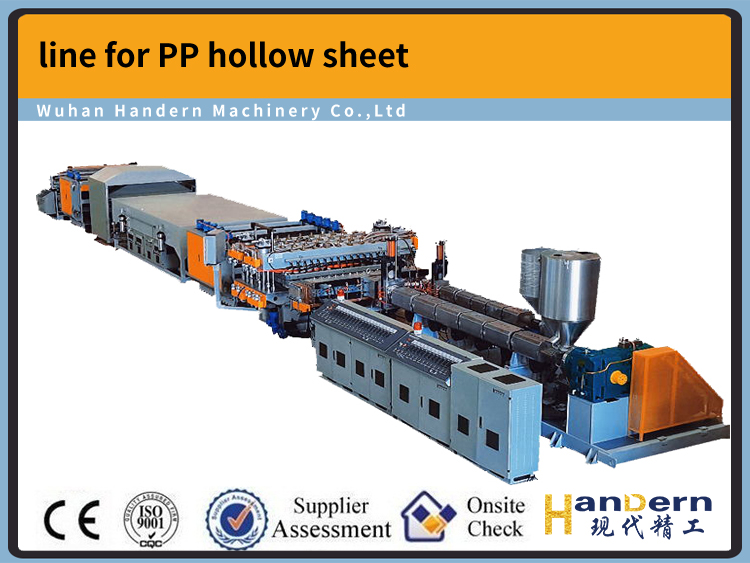
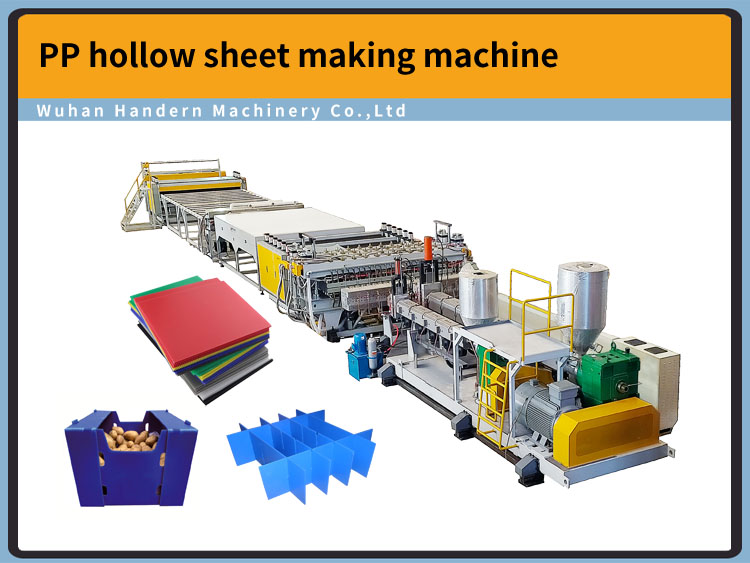
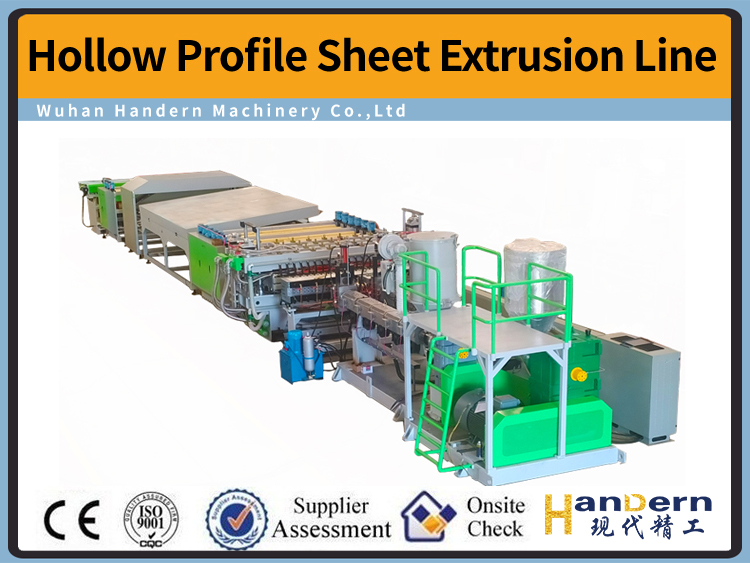
A bamboo-powder PP hollow sheet extrusion line can be split into material preparation, compounding and forming, and calibration and take-off. The sequence is the same as on a standard PP hollow sheet extrusion line; the difference lies in where margin must be left. The diagram below marks the four points that decide yield.
2.1 Front end: keep water and oversize particles out
The front end has one job: the material entering the barrel must be consistent, dry and uniform in particle size. Dry bamboo powder at around 105 °C to below 1% moisture, using desiccant drying with inline moisture measurement where available. Screen to 40–120 mesh; published work shows the best balance of mechanical properties and flow around 80 mesh. Coarser powder shows through the surface and blocks the die, while finer powder agglomerates, generates dust and feeds poorly. Dose bamboo powder, PP and additives separately with loss-in-weight feeders rather than volumetrically, because the bulk density of bamboo powder changes considerably with moisture.
2.2 Middle: compound to disperse, not to cut
The aspect ratio of bamboo fibre is the source of its stiffness, so the screw configuration has to be built around even dispersion with minimal fibre breakage: a co-rotating twin-screw, sufficient L/D, a mild kneading-block arrangement, and an effective vacuum vent that removes moisture and volatiles. One detail is easy to miss: a blocked vent is the most common disguise of a "bubble problem". Many plants change the formulation three times when the real cause is a dead vent.
The hollow sheet die is extremely sensitive to melt-pressure pulsation, and when pressure moves, wall thickness moves with it. Melt filtration and a melt pump ahead of the die are therefore more necessary with bamboo powder than with plain PP.
2.3 Back end: die and calibration set the profile and wall thickness
The die distributes flow to each rib through its distribution ribs; where a skin is required, skin and core can be co-extruded, for example a bamboo-rich skin for appearance and printability over a high-stiffness core. Vacuum calibration sets rib straightness and wall-thickness uniformity, staged multi-roll cooling suppresses warping, and haul-off tension must be closed-loop with output. Unstable tension thins the longitudinal ribs or causes pile-up.
2.4 End of line: cap the regrind ratio
Inline regrinding and reuse reduces losses significantly, but regrind has been through a second heat history, and both interfacial bonding and colour degrade. The regrind ratio should be written into the process sheet as a controlled parameter, rather than letting the line take as much as it can.

3. Formulation decides how far the product can go
3.1 More bamboo powder is not better
Published work often reports 30%–50% filler in bamboo/PP composites, and laboratory conditions can push beyond 75%. A hollow sheet, however, is a thin-walled, multi-rib product whose structure is held open by vacuum calibration; it demands higher melt strength and more stable calibration. The practical window is therefore much narrower, and it has to be set together with wall thickness and rib count.
表格
| Bamboo powder content | Typical products | Indicators you must hold | Process notes |
|---|---|---|---|
| 20%–30% | Signage, light-duty packaging boxes, liner sheets | Surface flatness, print and lamination adhesion | Processing window close to plain PP; a good entry formulation |
| 30%–40% | Standard totes and packaging boxes | Impact strength, static stacking load, drop performance | Coupling agent and lubricant must work together; leave margin in calibration |
| 40%–50% | Heavy-duty packaging boxes, protection panels, pallet deck boards | Flexural modulus, creep resistance, water absorption | Highest venting and dispersion load; lower barrel temperatures |
3.2 Additives: the logic of the four-part system
- Coupling agent (MAPP). Published work on a 33% bamboo powder/PP system puts the optimum at 9% by weight of bamboo powder, improving the interface, impact strength and water absorption at the same time; beyond that the gain flattens, and an interfacial layer can even embrittle the compound. Practical formulations sit in the 3%–9% range and need a trial matched to mesh size and wall thickness.
- Lubricants. Bamboo powder drops melt flow rate from about 21 g/10 min for plain PP to 9–15 g/10 min. Internal lubricant lowers viscosity, external lubricant improves release and surface, and the dosage has to move with filler content.
- Antioxidant and heat stability. Bamboo powder scorches and yellows during long residence above 180 °C. The antioxidant package and a lower-temperature process are one combined measure, not two independent knobs.
- Coupling or dispersing agents (optional). Silane and titanate types are chosen according to how the bamboo powder is pre-treated. They are not mandatory, and overdosing hurts release and surface.
3.3 Different box types need different formulations
Packaging boxes are the largest application for PP hollow sheet and the toughest test for a formulation: static stacking looks at creep, handling and drops look at impact, cold chain and sea freight look at moisture uptake, printing and lamination look at surface energy. Same PP hollow sheet extrusion line, different formulation, a completely different product.
Wuhan Handern Machinery Co., Ltd. has independently developed and mastered material formulations for multiple material systems and multiple specifications of PP hollow sheet packaging boxes, and can provide scientifically sound formulations matched to customer requirements and different use scenarios.
On the line, that statement means three things. First, the material system is not limited to bamboo powder: wood flour, calcium carbonate, talc and regrind can all be combined. Second, the range runs from thin sheet to thick sheet and from two-rib to multi-rib profiles, so the die and the calibration section must be adjustable together with the formulation. Third, a formulation is not a piece of paper but a reproducible window: temperature profile, screw configuration, vacuum level and haul-off speed. Miss one of them and it cannot be reproduced.

4. Six problems you will actually meet on the line
Most complaints about bamboo-powder systems come down to a limited set of causes. The table is arranged as symptom, likely cause and what to do, and works as the first troubleshooting sheet after start-up.
表格
| Symptom | More likely cause | What to do |
|---|---|---|
| Bubbles, silver streaks on the surface | Moisture in the bamboo powder too high; or the vacuum vent is ineffective and blocked by fines | Re-dry below 1%; check the vent and the screen pack before touching the formulation |
| Broken longitudinal ribs, uneven wall thickness | Melt-pressure pulsation; imbalanced flow across the die distribution ribs; unstable haul-off tension | Add a melt pump to stabilise pressure; clean and re-set the die; close the loop between haul-off and output |
| Low impact strength, whitish interfacial failure | Insufficient interfacial bonding with too little coupling agent; or too much, forming a barrier layer | Run a trial across the 3%–9% range on bamboo powder weight and set the level from drop and impact data |
| Rough surface, visible bamboo particles | Poor dispersion; powder too coarse; local melt temperature too low | Adjust the kneading blocks and dispersive section; move to 80 mesh or finer; check the temperature profile |
| Rising torque, fast screw and barrel wear | Abrasive bamboo powder; regrind ratio too high; screen pack left in service too long | Specify a wear-resistant barrel and screw; cap the regrind ratio; set a screen-change interval |
| Uneven colour, local scorching | Local overheating; residence time too long; material building up in dead spots | Lower the rear-zone temperatures; raise output to shorten residence; strip and inspect dead spots |

5. Conclusion: the machine is the skeleton, the formulation is the soul
Bamboo-powder-filled PP hollow sheet is not a cost-down project that simply stirs cheap powder into resin. It is a system job that aligns raw-material behaviour, PP hollow sheet extrusion line capability and the formulation window. Done well, the customer gets a lower cost per piece, better stiffness and an environmental story that can go into a specification sheet. Done badly, the customer gets bubbles, broken ribs and a process card that never settles.
For a machine builder, the real dividing line is not screw diameter or headline output. It is whether the formulation and the process window are delivered together. Bamboo powder is not a cheap substitute; it is a raw material that has to be taken seriously.
Author:admin